Cow Parsnip – Heracleum maximum W. Bartram
Family Apiaceae
Photo Gallery
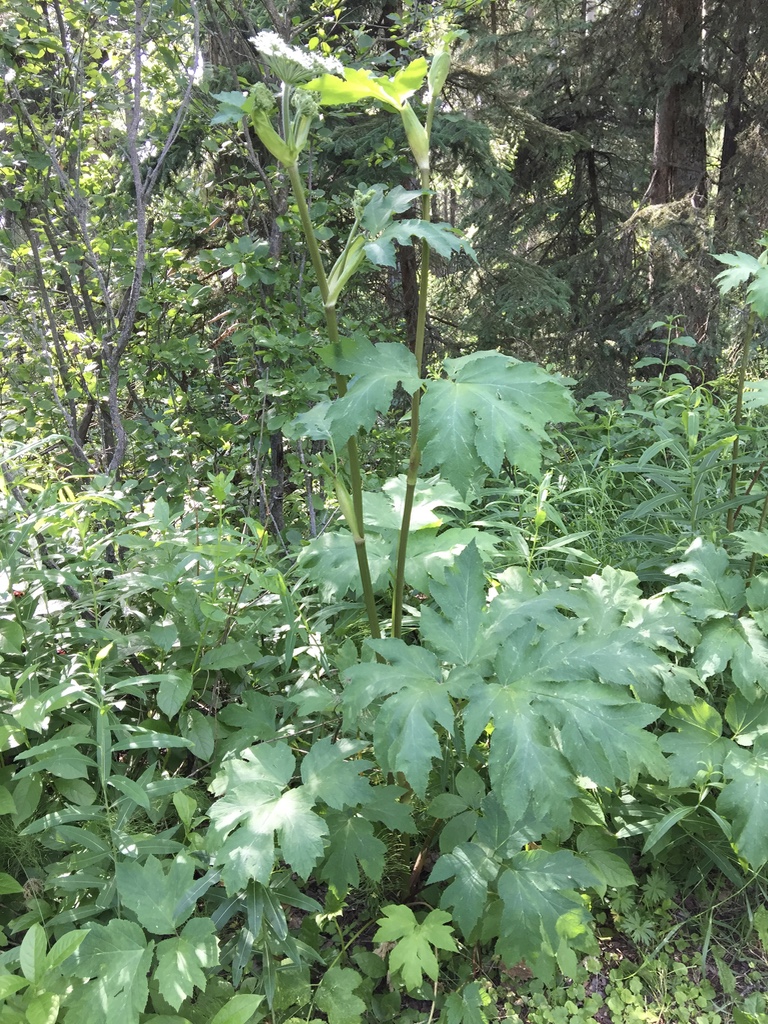
Whole Plant
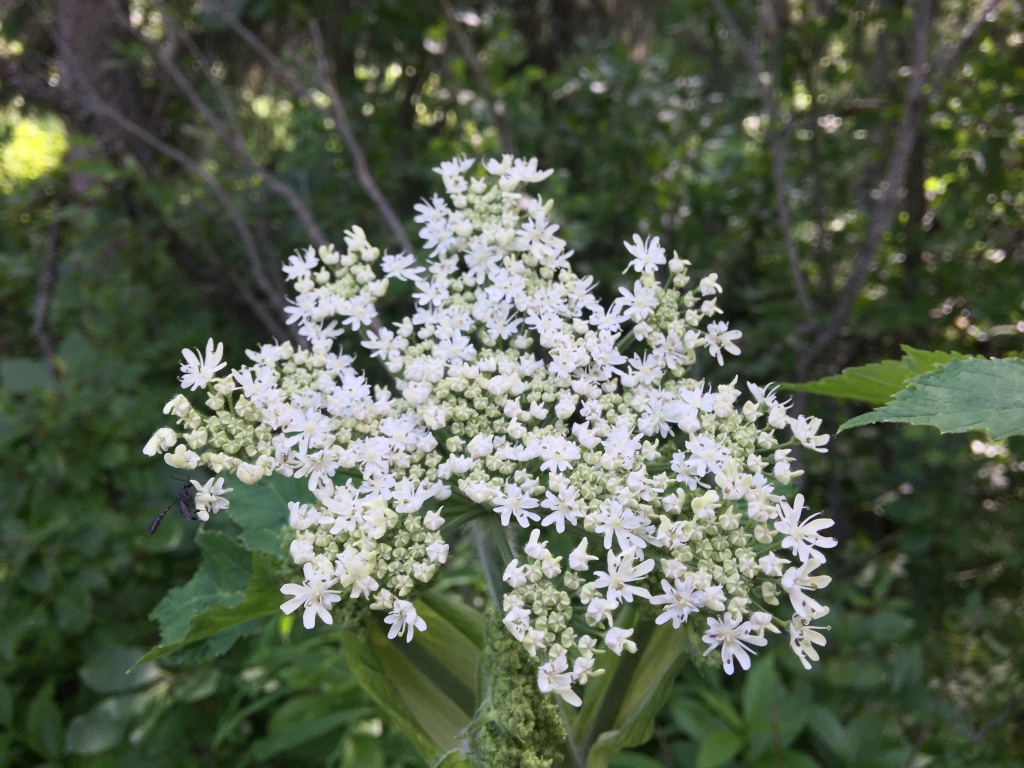
Flowers/Inflorescences
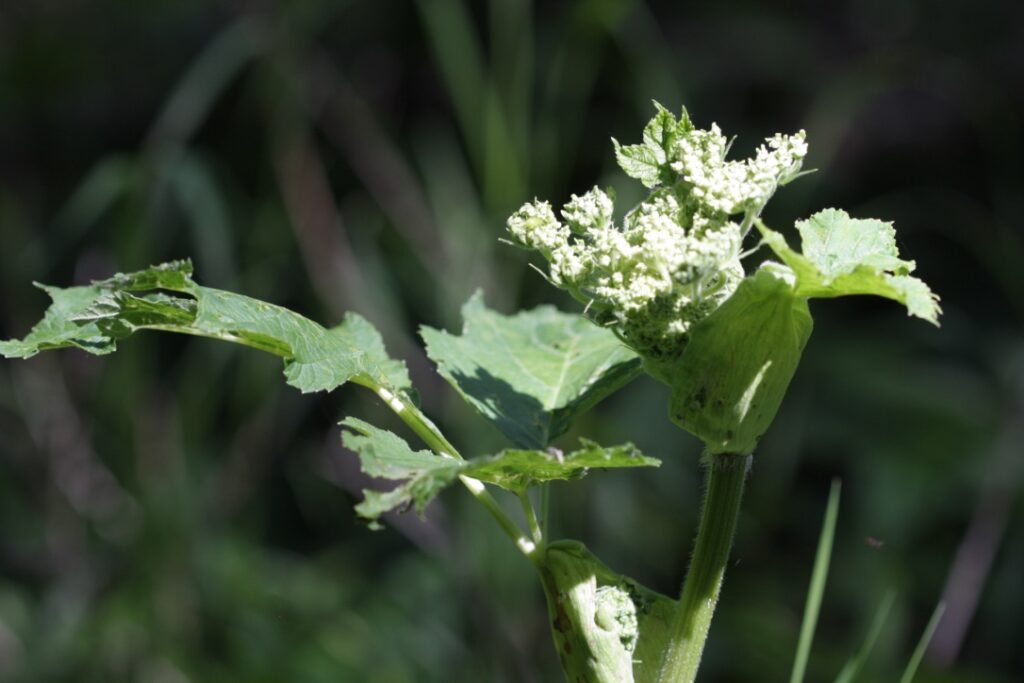
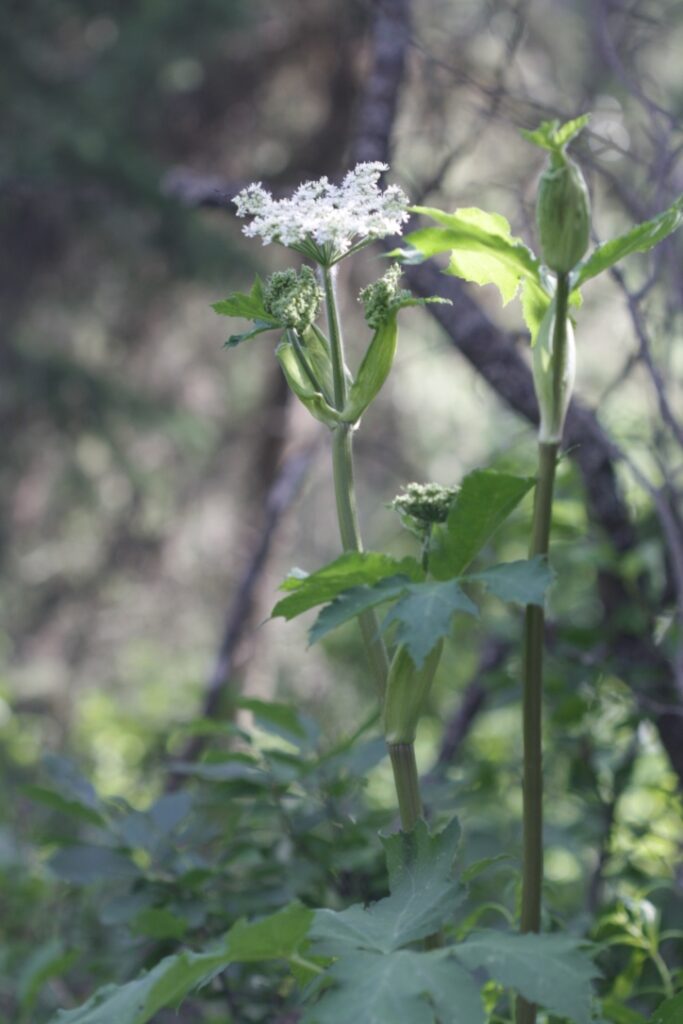
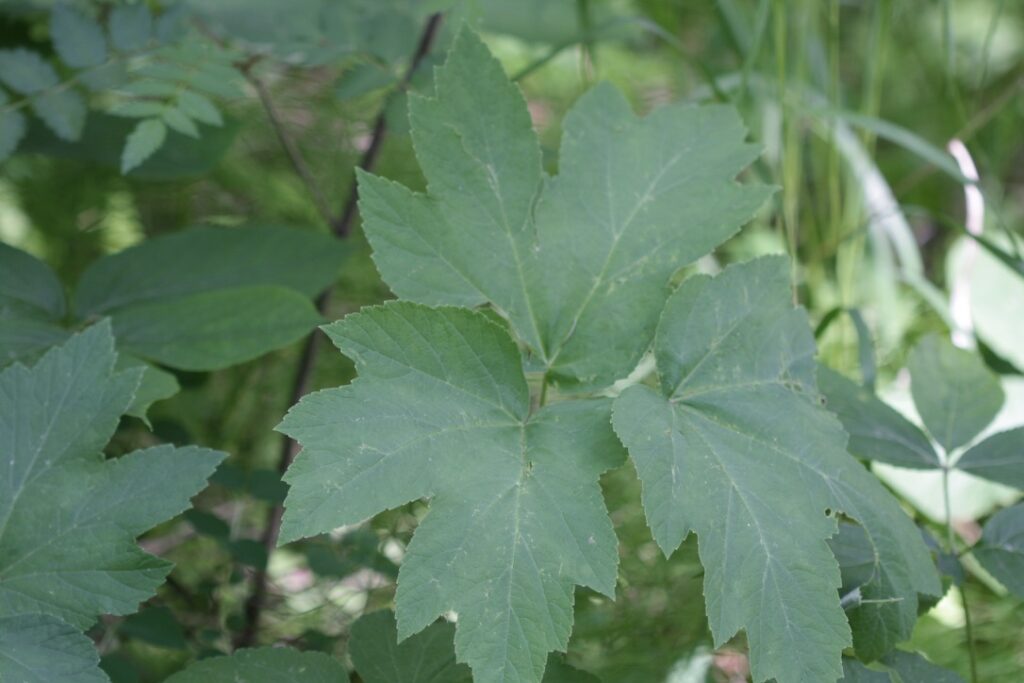
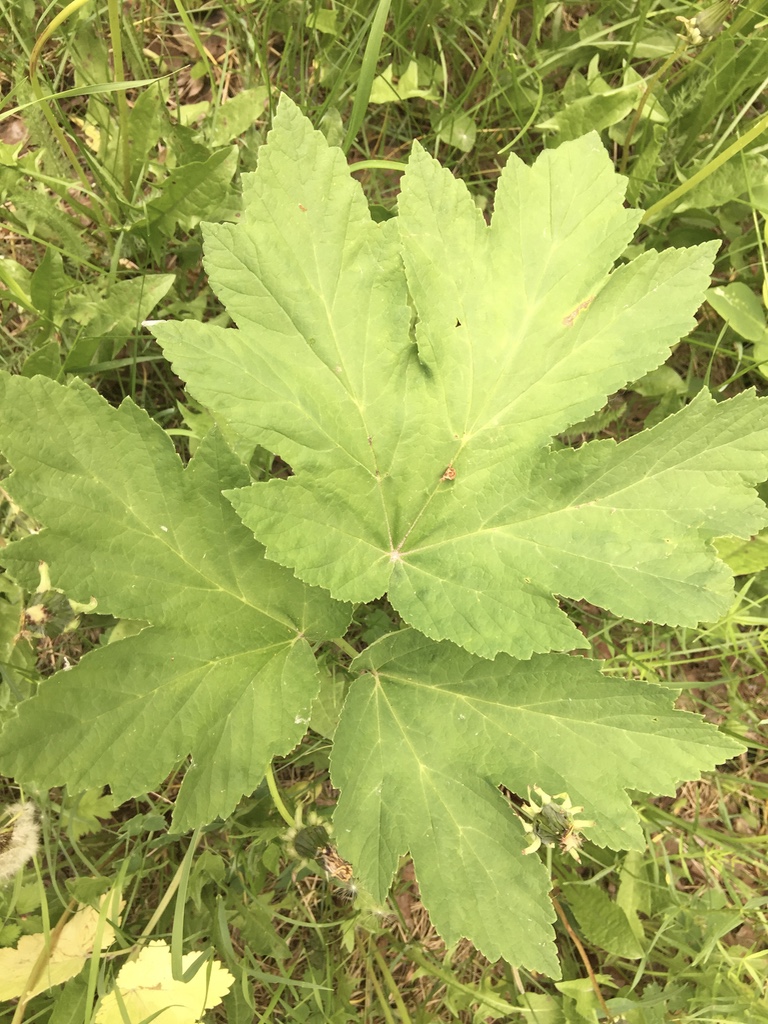
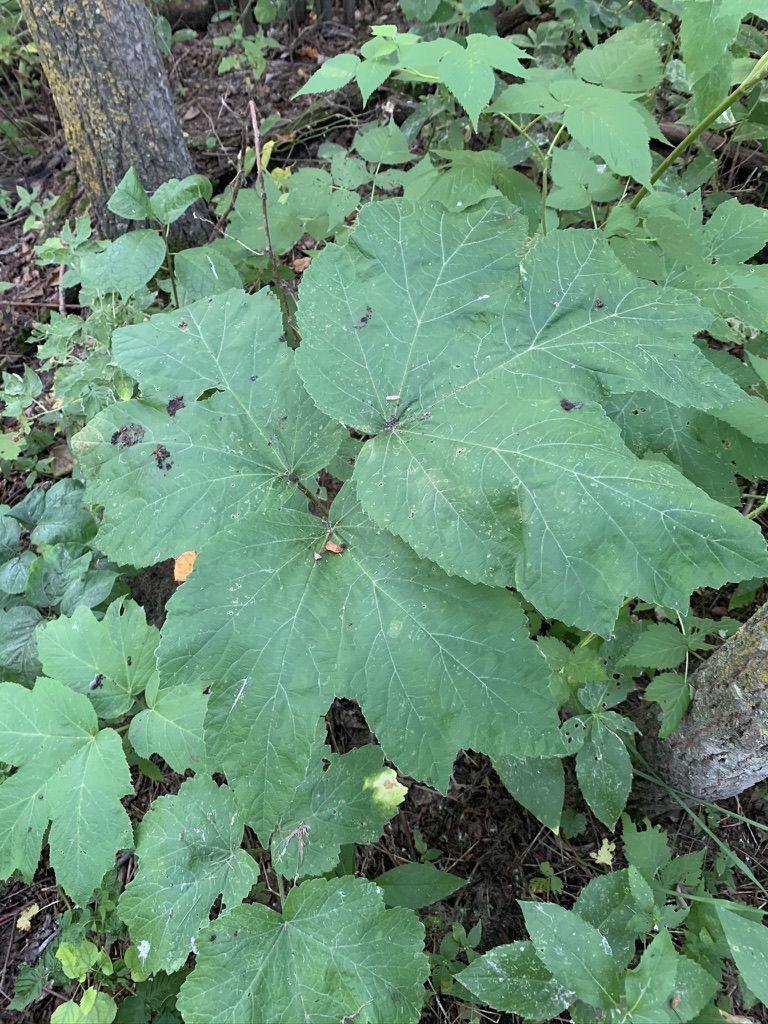
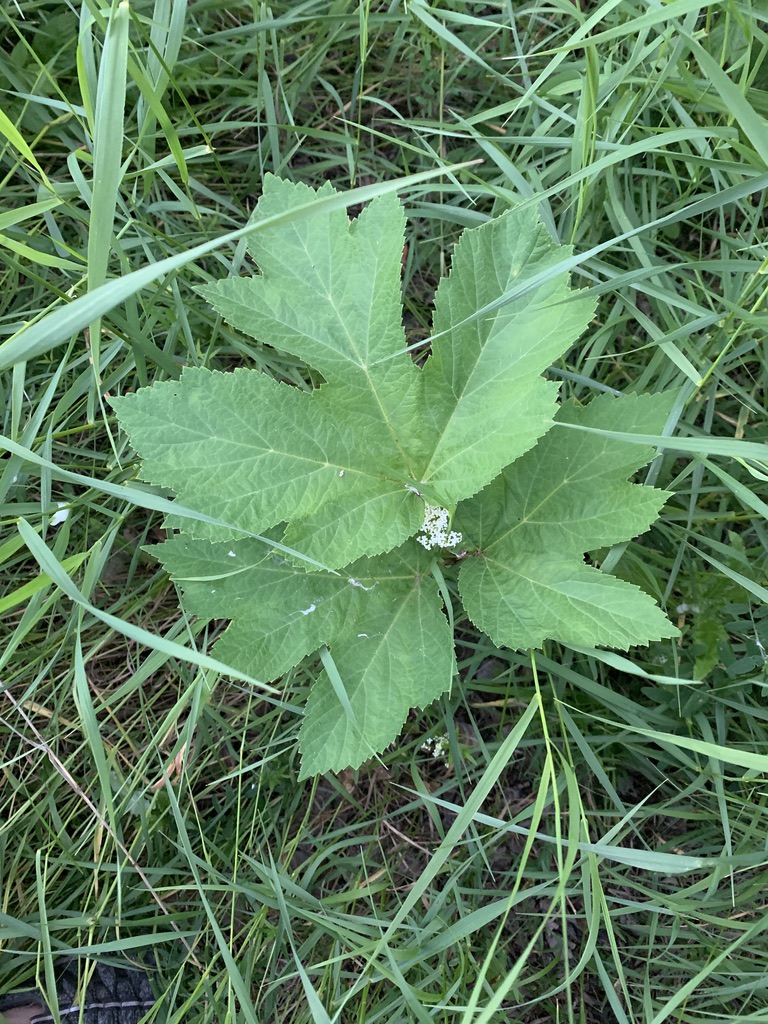
Leaves
In the Vegetative Stage
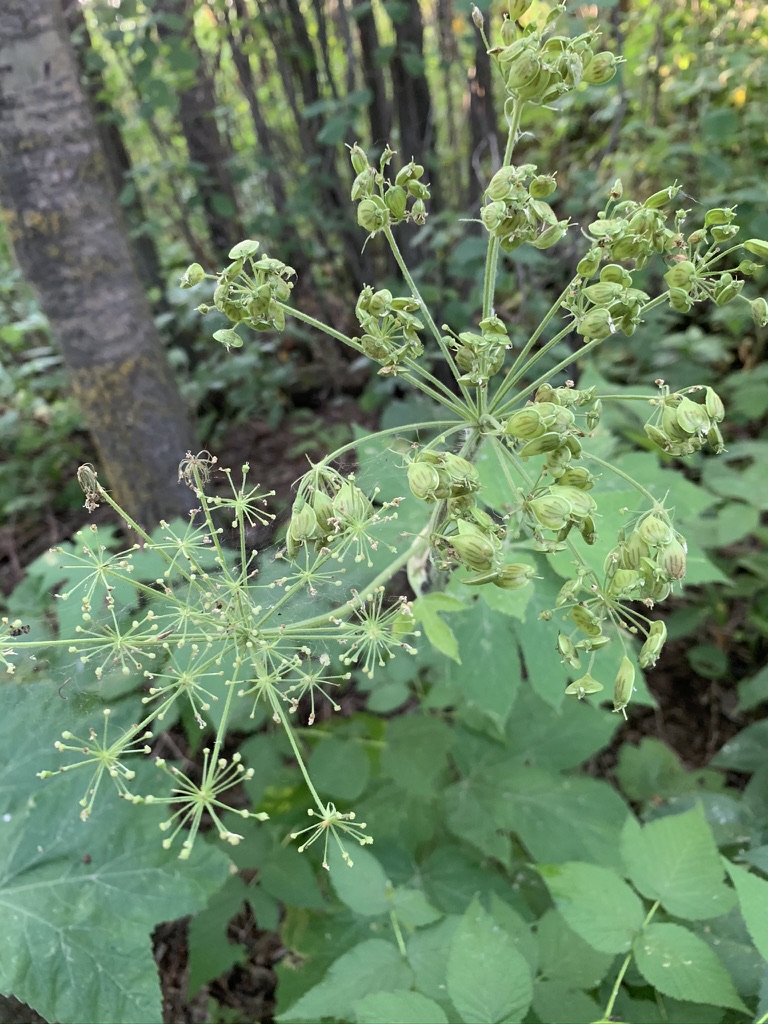
Seed-set or Maturity
Origin & Status
- Native or non-native to Western Canada? Native
- If non-native, where is it considered a native species? N/A
- Is this plant generally considered a nuisance weed or not? Generally, no. Some (especially gardeners) consider it a “weed” due to its somewhat toxic sap, which can cause photosensitivity when it comes into contact with skin. See “Is This Species Poisonous or Edible?” below for more info.
- Common or rare? Common.
Dichotomy-like Description
Growth Habit
- Monocot or dicot? Dicot.
- Erect, prostrate, creeping, or climbing? Erect.
- What is its life cycle? Perennial.
Overall Height
- 1 to 2 m (3 to 6 feet)
Stem Characteristics
- Solitary stem or bunching together? Solitary stem.
- Pithy or hollow? Hollow.
- Square, round, or triangular? Mostly round.
- Clear or milky sap? Clear.
- Also: Coarse, sparsely to densely woolly-hairy.
Rooting Type
- Stolons or rhizomes present? No to both.
- Fibrous roots or taprooted? Stout taproot, with some clustered fibrous roots.
Leaf Arrangement on the Stem
- Are leaves arranged opposite, alternate, whorled or as basal rosette? Basal rosette predominantly, cauline leaves also present.
- How are leaves attached to the stem? Short petiole or stalk.
- Axial leaves present? Yes, several both proximally and distally.
- Stipules present? No, they are conspicuous, swollen, hairy, dilated sheaths that may be mistaken for stipules.
Leaf Characteristics
Simple or Compound leaves? Compound.
- (If Compound) What type of division? Ternate
- (If Compound) How many leaflets per leaf? Three.
- What is its (including leaflets) shape? Palmately lobed; cordate-based
- Leaf edges smooth or toothed? Toothed.
- If toothed, is it fine or coarse or other? Coarsely so.
- Are the leaves eared? No.
- Do they have auricles? No.
- What is their size? Large: 10 to 30 (40 cm) long and equally broad.
- What is the veining characteristics? Hairs on veins.
- Is there any colouration to note? Paler on under side.
What other characteristics are there of note? Soft-hairy below (especially on veins) and nearly hairless above
Inflorescence Type
Raceme, panicle, cyme, spike, umbel, corymb, twinned, singular, etc.? Compound Umbel.
- Length of flower cluster: 10 to 30 cm wide.
- Other characteristics: Each umbel ray is up to 10 cm long, and there are 15 to 30 per inflorescence.
Flower Colour
- What colour are the petals? White
- What colour are the sepals? Green
- What colour are the stamens? Cream to white; often hard to see unless dissecting individual flowers under a magnifying lens or dissecting microscope.
Flower Size
Variable:
- Very Small (<~1/4″) – smaller than a pea (middle flowers)
- 6 mm (~1/4″) – pencil-width (closer to edge)
- 1.2 cm (~1/2″) – pea-sized (on outside edge)
Flower Composition
Regular, composite, irregular, or pea-like? Irregular to regular.
(If regular) Number of petals? Four.
- Petal shape, in general? Deeply notched.
(If regular [& some irregular]) Shape of corolla: trumpet-like, flat, cupped, bell-shaped, etc.? Flat.
- (For regular & irregular flowers) Is the ovary superior or inferior to the petals & sepals? Inferior ovary.
(If irregular) are [outer] petals longer or shorter than [inner] petals? Some petals are larger than others; the flowers on the outside of each umbel may be longer and larger than the petals on the inside, but this is not noticeably consistent.
- Are [outer] petals divided or entire? Divided.
- If divided, how many times? Once. Petal looks more deeply notched than divided.
- Are [inner] petals split or entire? Split, but less so than larger petals.
Any hair-like structures on flower parts? No.
Fruits & Seeds
What type of fruit or seed pod does this specie produce? Flattened, winged fruit
- What is its size? About 1 cm long.
- What is its shape? Obovate.
- Are there any other features to note? Fruits have narrow ribs and oil tubes (dark vertical lines) visible, and are hairless to finely hairy. Winged on margins.
Where to Find This Species
What ecoregions and habitats does this plant most commonly occur in? All ecoregions except the Prairies. It prefers woods and thickets with ample moisture (but not saturated), moist meadows, and slopes at higher elevations.
What plant community is this plant found in, or occupies as the dominant species? Cow parsnip serves as an indicator of fertile mesic-subhygric ecosites that is often associated with ferns and deciduous woody species such as Prickly Rose (Rosa acicularis), Wild Raspberry (Rubus idaeus), Saskatoon (Amelanchier alnifolia) and Trembling Aspen (Populus trembuloides).
Which states/provinces can this species be found in? All Canadian provinces & territories except Nunavut. It is also found in most of the United States except the Deep South and the Gulf Coast, from Texas east to Florida and South Carolina, with some plants showing up in the state of Georgia.
When to Find Blooms/Inflorescences
What time of year is this plant most likely to bloom? What seasons to expect, and what months of the year? Leaves begin to emerge in late May/early June, and the plant shoots up a tall stalk and blooms from July to early August.
Is this Species Poisonous or Edible?
Is this species edible or has any poisonous or toxic properties that you need to be aware of? It is not edible; it has some toxic properties that will cause skin burns and photosensitivity if the plant’s sap makes contact with skin.
THIS PLANT CAN BE TOXIC WHEN HANDLED, TOUCHED, OR ACCIDENTALLY BRUSHED UP AGAINST. While it’s not as potent or dangerous as H. mantegazzianum above, it still produces chemical compounds (furanocoumarins such as xanthotoxin, angelicin, pimpinellin and isopimpinellin, isoimperatorin, bergapten and isobergapten, 6‐isopentenyloxyisobergapten, and sphondin) that react with the skin, causing burns and photosensitivity if it comes into contact with skin. Please be very careful when handling this plant. Ideally, avoid touching or handling it if you find H. maximum on your walks.
Synonyms & Other Names
Other scientific names this plant is or has historically been known by:
- Heracleum douglasii DC.
- Heracleum inperpastum Koidz.
- Heracleum lanatum Michx.
- Heracleum sphondylium var. lanatum (Michx.) Dorn
- Heracleum sphondylium subsp. lanatum (Michx.) Á.Löve & D.Löve
- Heracleum sphondylium var. tsurugisanense (Honda) H.Ohba
- Heracleum turugisanense Honda
- Pastinaca lanata Koso-Pol.
- Sphondylium lanatum (Michx.) Greene
Other common names this plant has been known by (English only):
- American cow-parsnip
- Indian celery
- Indian rhubarb
- Pushki
- Satan celery
- Poison turnip
- Masterwort
What Other Species Can this be Confused With?
What other species may you confuse this with?
- Giant Hogweed (Heracleum mantegazzianum)
- Common Yarrow (Achillea millefolium)
What are any details to help distinguish this species from others?
Giant Hogweed (Heracleum mantegazzianum) is a European non-native invasive, prohibited noxious weed in North America. H. mantegazzianum is fairly easily identified due to its far larger size (it will grow up to 20 feet [6.1 m] tall) as well as purple splotches along the stems and sharply serrated leaves. According to the Alberta Invasive Species Council, H. mantegazzianum has not been confirmed in Alberta, Saskatchewan, or Manitoba; however, it has been found in Ontario, Quebec, the Atlantic provinces, and British Columbia. H. mantegazzianum has gained its infamy due to its ability to produce chemical compounds that cause serious burns and blistering when bare skin is brushed up against any part of the plant, especially when the skin is exposed to UV light from the sun.
Common Yarrow (Achillea millefolium) is a much smaller plant that grows only 10 to 30 cm tall and has very fine, almost dainty, fern-like leaves. The flowers are also more regular, and all flowers in the umbel, from the centre outward, are equal in size. A. millefolium also prefers to grow in more xeric, open ecosites than H. maximum, often found in open grasslands, moist prairies, and on open hillsides. It does not like to grow in forests or thickets.
Interesting Notes
Is there any value of this plant for grazing herbivores, both domesticated and wild?
Surprisingly, yes. H. maximum is edible for livestock and wildlife, with foliage fairly nutritious throughout the growing season. Young growth is particularly palatable. As a large, leafy species that often forms thick stands, it is one of our most productive forbs in native rangelands.
This species can withstand fairly heavy grazing because it stores large energy reserves in its roots and produces an abundance of seed every year. However, if animals continue to favour it over other plants, its population will decrease. Some range agrologists argue it’s a decreaser; others an increaser; however, it depends on livestock accessibility as well as overall grazing utilization of areas that contain H. maximum.
What pollinators love to visit (if forb or flowering shrub)? Native bees, predatory wasps, syrphid flies, and beetles.
Is it commonly used for reclamation purposes? No.
Any stories about name origins or name meanings to share?
The genus Heracleum is named after the Greek demigod Hercules due to the speces’ large, vigorous growth form. Old taxonomies had the species name lanatam; this translates into woolly, alluding to the hairs found on the plant. Newer taxonomies changed the species name to maximum, which means big, referring to its impressive size when compared to surrounding plants in the forest.
Links for More Information
- iNaturalist – https://www.inaturalist.org/taxa/53094-Heracleum-maximum
- Saskatchewan Wildflowers – https://www.saskwildflower.ca/nat_Heracleum-sphondylium-ssp-montanum.html
- Texas A&M Lady Bird Johnson – https://www.wildflower.org/plants/result.php?id_plant=HEMA80
- Minnesota Wildflowers – https://www.minnesotawildflowers.info/flower/common-cow-parsnip
- Montana Field Guide – https://fieldguide.mt.gov/speciesDetail.aspx?elcode=pdapi15040
- USDA Forest Service – https://www.fs.usda.gov/database/feis/plants/forb/hermax/all.html
- E-flora BC – https://linnet.geog.ubc.ca/Atlas/Atlas.aspx?sciname=Heracleum+maximum