Plains Rough Fescue – Festuca hallii (Vasey) Piper
Family Graminaceae | Tribe Poeae
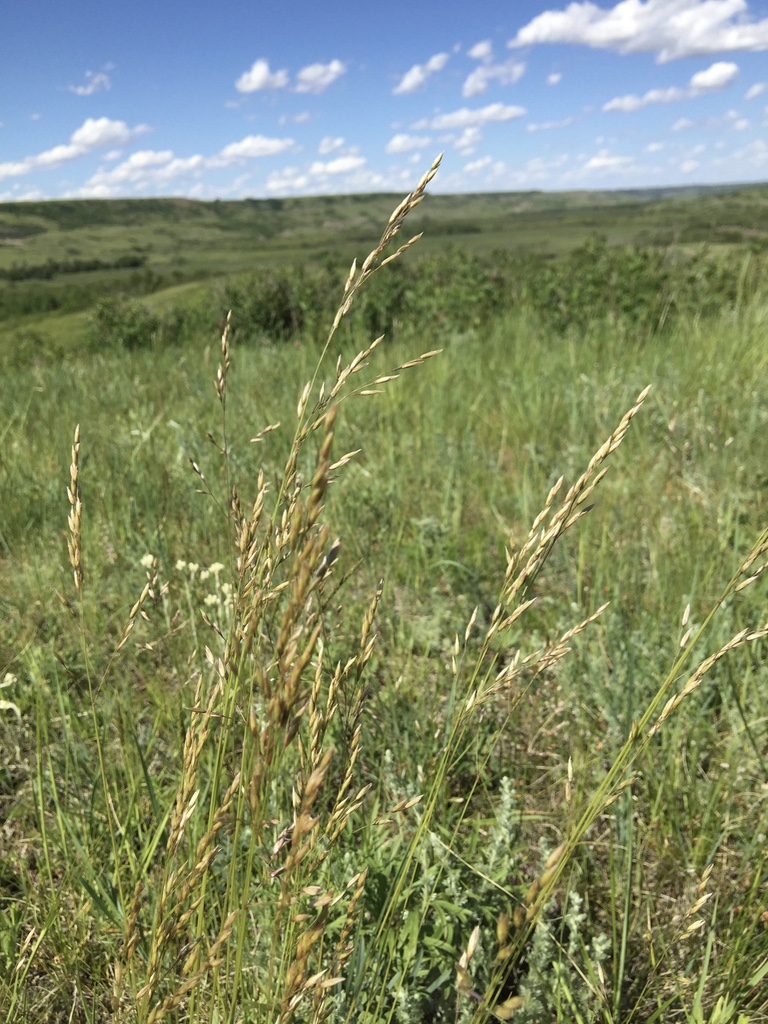
Photo Gallery
Whole Plant: At Maturity
Whole Plant: Vegetative Stage
Flowers/Inflorescences
Leaves & Collars
Origin & Status
- Native or non-native to Western Canada?
- If non-native, where is it considered a native species?
- Is this plant generally considered a nuisance weed or not?
- Common or rare?
Dichotomy-like Description
Growth Habit
- Erect or prostrate?
- What is its life cycle?
Overall Height
- _____cm (____ inches)
- OR ____ m (____ feet)
Stem Characteristics
- Bunched or creeping-rooted?
- Pithy or hollow?
- Square, round, or triangular?
Rooting Type
- Rhizomes present?
- If rhizomes present, are they short or long?
- Shallow or deep-rooted?
Leaf & Collar Characteristics
Leaf width:
- Wide or narrow?
- Rolled, flattened, indented?
- Lax or stiff?
- What width?
Leaf tip:
- Boat-shaped or sharply pointed?
Other leaf characteristics:
- Hairy or glabrous?
- Margins smooth or roughened?
- Any particular colouration to note?
- Rolled or folded at emergence?
Sheath shape/structure?
- What type of venation?
- What colour characteristics?
- With hairs or hairless?
Ligule present?
- If yes, what is its shape & structure?
- If yes, how long is it?
Collar shape/structure?
- What structure[s] describes its size?
- What colouration?
- Hairs or hairless?
Auricles present?
- If yes, are they distinct or rudimentary?
- If distinct, are there clasping claws or similar?
- If rudimentary, are there clasping claws or rounded extensions?
- If yes, are claws equal or not?
- If yes, what is their size?
Other characteristics to note?
Inflorescence Type
Raceme, panicle, or spike?
- Length of inflorescence?
If spike:
- Number of spikelets or flowers per node or joint
- Imbricate (folded, overlapping, shingled) or not?
- Long or short rachilla?
- Attached edgewise, flatwise, or otherwise to the stem (esp. for those in Tribe Triticeae)?
(Sedges/Rushes ONLY): Spikes singly on the stem, or in multiples?
- Number of spikes per stem, both male and female flowers.
- Location of male and female parts, or if on separate plants.
If panicle:
- Number of bracts per node or joint
- Long or short?
- Open or closed?
- Define if difference between flowering and seed set, like in Koelaria macrantha.
Inflorescence Colour
Is there any notable colouration to note on the inflorescence, spikelets and/or florets?
Spikelet & Floret Sizes
- Length of spikelets:
- Length of glumes:
- Length of lemmas/paleas:
- Length of florets:
- Length of awns (if present):
Inflorescence Composition
How many florets are there per spikelet, including sterile?
- Glumes unequal or equal?
- Glumes shorter, equal to, or longer than either lemmas, palea, or florets?
- Lance-shaped, awl-shaped, egg-shaped, or other notable shape?
- Pointed, awned, or dull?
- Straight or twisted awn?
- Where is the awn attached from?
Hairs on any parts of the flower?
- If so, which structures?
(Sedges & Rushes):
Number of perigyna per spike:
- Tight or loosely spreading?
- Beaked or not?
- Stigma or bristles present or absent?
- Number of stigma or bristles?
- Bracted distinctly or indistinctly?
- Achenes two-sided or more?
Seeds (For grass-likes only)
- What is the size?
- What is the shape?
- Hairless or has hairs?
- Are there any other features to note?
Where to Find This Species
What ecoregions and habitats does this plant most commonly occur in?
What plant community is this plant found in, or occupies as the dominant species?
Which states/provinces can this species be found in?
When to Find Blooms/Inflorescences
What time of year is this plant most likely to bloom? What seasons to expect, and what months of the year?
Is this Species Safe or Hazardous to Animals?
Is this species known for posing a hazard for humans and animals, particularly with awns?
Synonyms & Other Names
Other scientific names this plant is or has historically been known by:
Other common names this plant has been known by (English only):
What Other Species Can this be Confused With?
What other species may you confuse this with?
What are any details to help distinguish this species from others?
Interesting Notes
Is there any value of this plant for grazing herbivores, both domesticated and wild?
What pollinators love to visit, if applicable?
Is it commonly used for reclamation purposes?
Any stories about name origins or name meanings to share?
Links for More Information
- iNaturalist
- Saskatchewan Wildflowers
- Texas A&M Lady Bird Johnson
- Minnesota Wildflowers
- Montana Wildflowers
- USDA Plants Profile (or similar)
- E-flora BC
Origin & Status
Uncommon. Native to North America. Intact native grasslands in the moist mixedgrass prairie habitats are primary hosts of this species, which are sparse and in small pockets across the historic prairie/aspen parkland ecoregions of Western Canada.
Life Cycle
Perennial.
Synonyms & Other Names
Synonyms:
- Dalucum hallii (Vasey) Lunell
- Festuca altaica subsp. hallii (Vasey) V.L. Harms
- Festuca scabrella subsp. hallii (Vasey) W.A. Weber
Other common names:
- Prairie Wool (see Interesting Facts below for more information)
- Hall’s Fescue
Key Characteristics to Note
Festuca hallii is a bunchgrass. It has short rhizomes and can grow between 8 and 26 inches (20 to 65 cm) tall.
Leaf blades are narrow and long-pointed. They grow 12 inches (30 cm) long and are 1 to 1.5 mm wide. At emergence, they are folded, but become in-rolled with maturity. They feel rough above and smooth below. Most leaves are bluish or grey-green; however, I’ve seen F. hallii leaves that are less grey or blue-green than expected. Comparatively, they are more green than Elymus smithii (Western Wheatgrass).
Each bunch will produce several panicles that range from 6 to 15 cm (2.3 to 6 inches) long. They can be open or contracted. The spikelets are 2- to 3-flowered with the third floret sterile. Glumes are nearly equal (6 to 7 and 7 to 8 mm long) and as long as the first lemma (lemmas 7 to 8 mm long). These glumes are hairless, somewhat shiny, often suffused with purple, and the lemmas are more roughened with tiny hairs and purplish. There are no awns present.
Where & When to Find This Plant
F. hallii is found primarily in the Parkland Ecoregion as well as northern parts of the Prairie Ecoregion. It is a dominant grassland climax species commonly found with Blue Grama (Bouteloua gracilis). It may be challenging to find this plant in areas except where it has been largely untouched by cattle grazing and agricultural activities, such as in provincial parks such as Big Knife Provincial Park or Dry Island Buffalo Jump Provincial Park. Plants have also been found in the Rumsey Ecological Reserve and Rumsey Natural Area blocks, both of which comprise the largest tract of intact prairie/aspen parkland native habitat in the world. These plants tend to prefer mesic soils, or soil with good drainage.
Its range extends from the mixed grasslands and northern edge of the Great Plains of Alberta and Saskatchewan eastward to Ontario, with some populations occuring in the southern interior of British Columbia. It is also found in through Montana south to New Mexico according to the USDA Fire Service database.
F. hallii typically blooms during the summer months, from June to August (as I’ve observed). However, some years have seen climate conditions that discourage this species from sending up inflorescences, and they will remain predominantly vegetative instead.
Interesting Facts
F. hallii is a valuable rangeland species for both wildlife and livestock because of its high palatability and ability to retain its nutritional value in the winter months. However, poor grazing management and agricultural activities threaten its existence. Some have estimated that less than two to five percent of intact F. hallii rangelands remain; these are small, isolated pockets in well-managed private or federally/provincially protected lands.
Other challenges include its high dependence on seed production for its ability to spread, making a species that is slow to establish and have “poor” reproductive ability when compared to more aggressive plants like Bromus inermis (Smooth Bromegrass). Seed production can also be quite variable, as in some years, F. hallii may produce very little to no seed, and in other years, conditions will be perfect for seed production, such as that pictured above.
Its tendenncy towards seed production is thought to have much to do with environmental stresses. Normally, plants that feel stressed by drought or excessive moisture or heat or cold will put their energy reserves into sexual reproduction (seed production) to ensure that the next generation will survive and come after them, should the parent plants die.
Festuca hallii also stands as the provincial grass of Alberta.
Ranchers call it “Prairie Wool” because of the many clumps of dead, brownish-grey plants that look similar to sheep’s wool it forms after snowmelt.
Prime Rangeland Fodder for Livestock & Wildlife
Rough fescue provides high quality forage for livestock and wildlife, especially for winter or early-spring grazing, however animals will graze this plant at any time of the year. As with all plants, young, fresh green leaves and stalks are the tastiest. Quality and “taste factor” (or palatability) declines as plants reach maturity. Rough fescue maintains its quality into winter, curing on the stem as it matures. This makes it a highly sought-after food source for grazing animals in the winter, late fall, or early spring when food resources are scarce.
However, old residue from previous years can reduce palatability. Studies have shown that elk favour winter grazing rough fescue if the old residue is cleared out by fire and grazing (primarily by cattle). Studies also have shown that heavy grazing, overgrazing, and grazing in early fall or summer will result in the decrease of rough fescue stands, allowing “increaser” species such as Parry’s Oat Grass (Danthonia parryi), Idaho fescue (Festuca idahoensis) and wheatgrasses (Family Triticeae) to take over. It thrives better under winter grazing. Hence, all rough fescue species are regarded as “decreasers” in discussions of rangeland management.
The migration patterns of the Plains Bison (Bison bison bison) have traced them to spend their summers in the southern Great Plains (mainly in the midwest and east of the Rockies of the United States) and then move north to Canada for their winter range. They are thought to have only gone as far north as the Aspen Parkland ecoregion and the prairie fescue grasslands and west to the foothills east of the Canadian Rockies (with some animals venturing into the mountain valleys as well).
Grazing by bison has been called “moderate” by scientists and biologists. Thus, bison probably utilized those plants as their primary nutrition source in the winter, along with sedges and other grasses. When it was time to migrate back south for their summer grazing (a few scattered groups of bison remained behind, similar to the animals of the Serengeti in Africa), these rough fescue plants were left behind and allowed to recover, grow, and reach maturity before the bison returned. Thus, it is believed that rough fescue may have evolved in conjunction with winter grazing habits of the old enormous bison herds.
However, another theory that scientists argue is that bison herds, because of their enormity, move with grass availability. When they run out of grass to eat because it gets heavily trampled and soiled with their manure, they head wherever their matriarchs or patriarchs go to wherever there is best grass. And, where they go depends on where the rains fell and when. Bison historically had a huge range that stretched up to the northern Great Plains and south almost to the Gulf of Mexico. If there was more grass up north, they would head up north and graze there before conditions may be more favourable for them to head back south. And, after they leave, often they won’t come back to that area for several years. Thus, arguably, rough fescue may not have evolved with the winter grazing habits of bison, but rather evolved with the infrequent yet hard grazing they recieved with bison following the rains and the best places to eat.
Suitability/Use for Reclamation
It is a common plant to use in a reclamation mix to establish disturbed sites in prairie grassland. However, its use is challenging due to high seed prices, short supply, and the long establishment period. Once this species successfully establishes itself, though, the persistence of this beautiful grass is quite admirable.
Sources for More Information
iNaturalist – Rough Fescue- https://www.inaturalist.org/taxa/162950-Festuca-hallii
Lady Bird Johnson – Festuca hallii – https://www.wildflower.org/plants/result.php?id_plant=feha3
USDA Forest Service – Festuca altiaica, F. hallii, F. campestris – https://www.fs.usda.gov/database/feis/plants/graminoid/fesspp/all.html