Western Wheatgrass (Pascopyrum smithii) (Rydb.) Á. Löve
Family Graminaceae | Tribe Triticeae
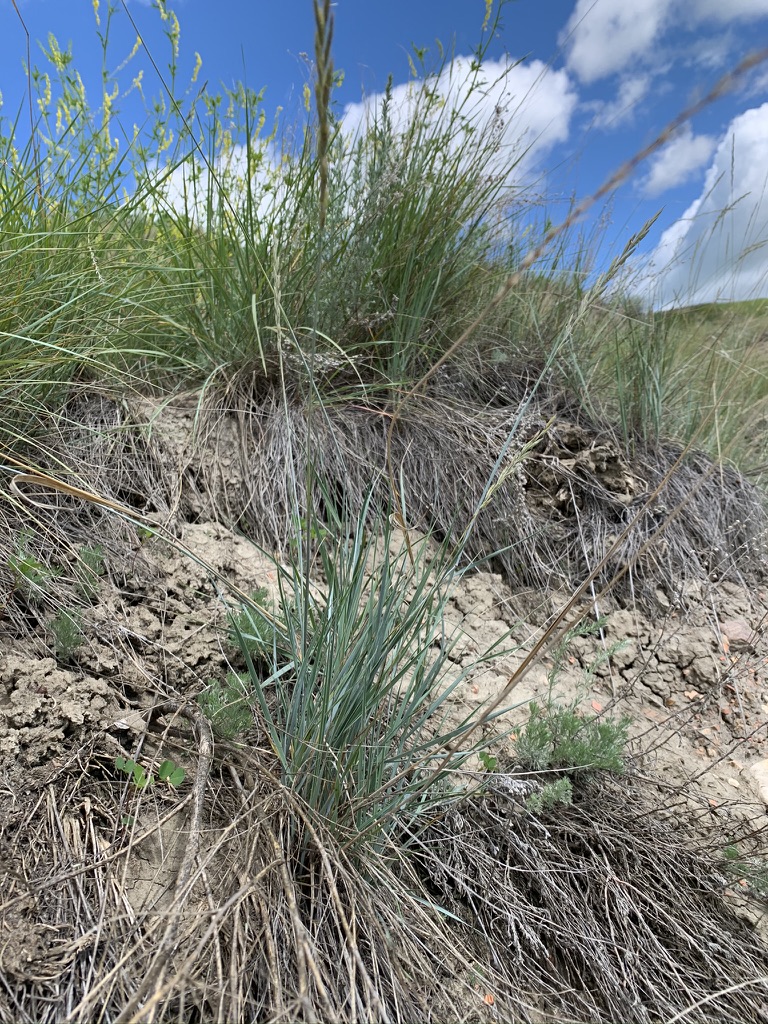
Photo Gallery
Whole Plant: At Maturity
Photos coming soon!
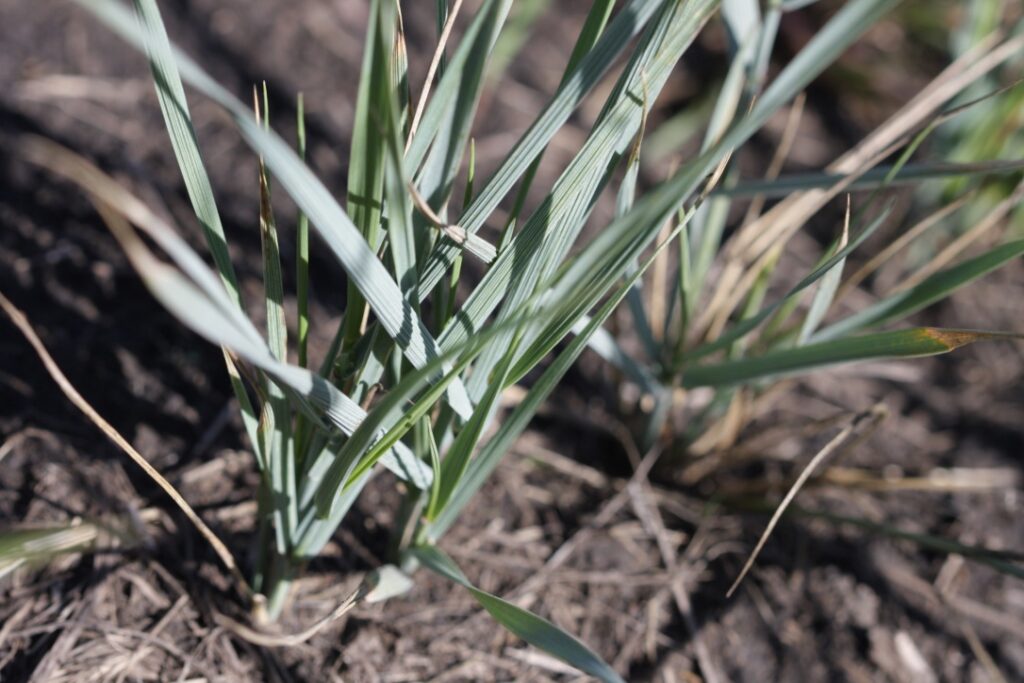
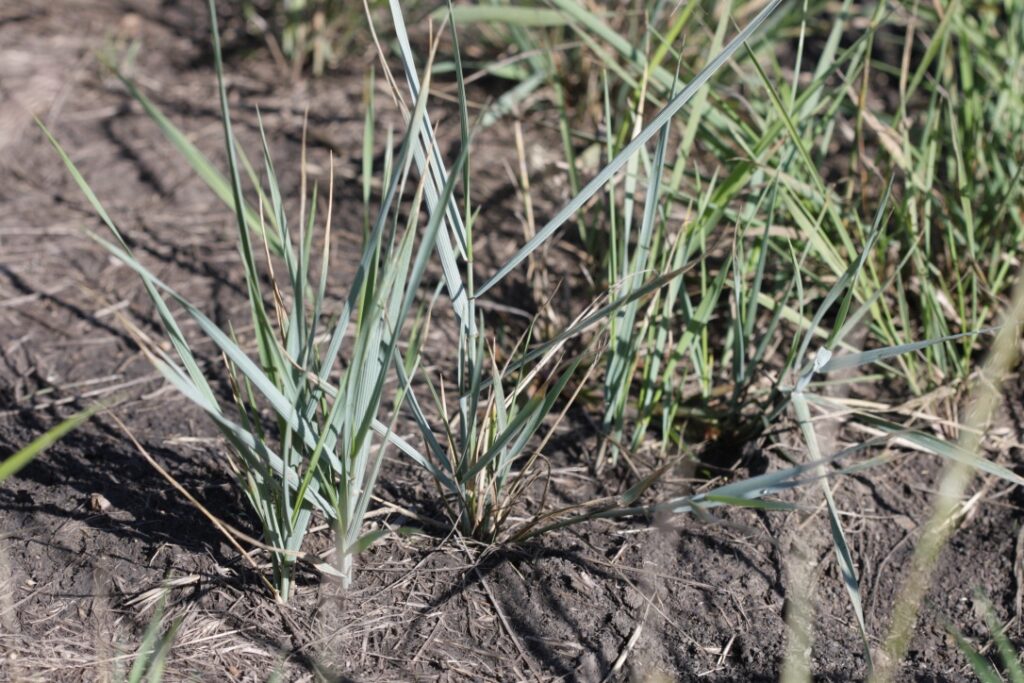
Whole Plant: Vegetative Stage
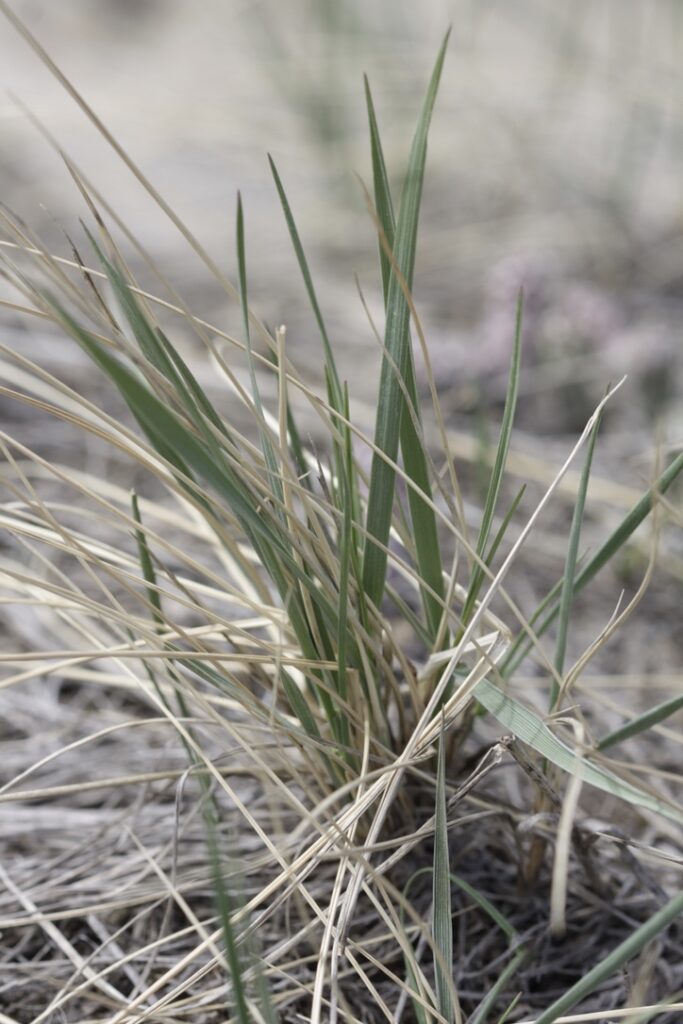
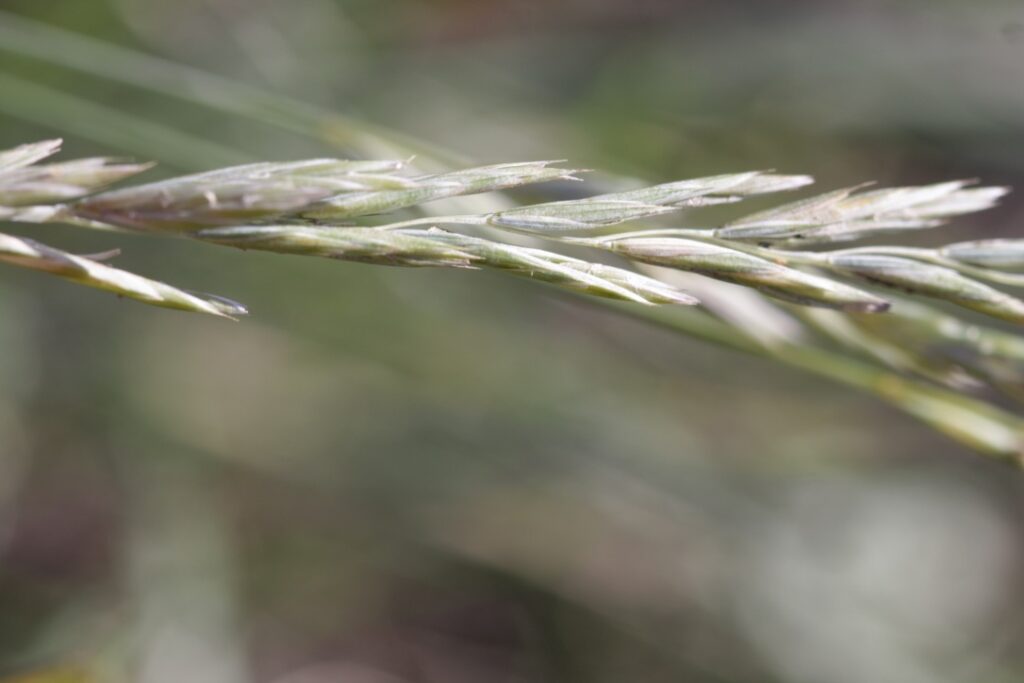
Flowers/Inflorescences
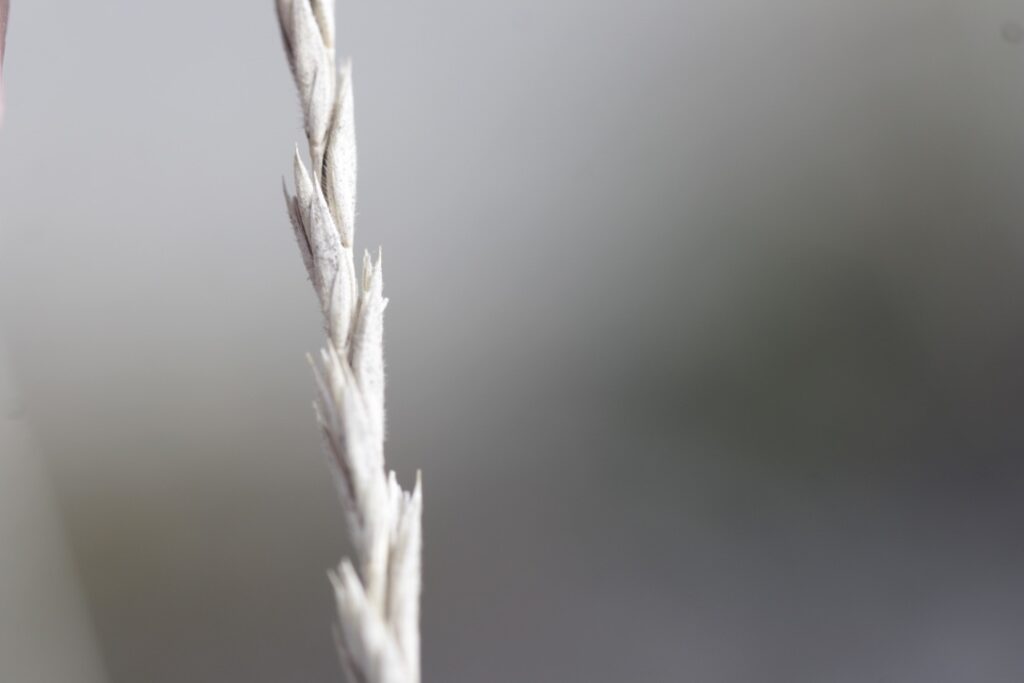
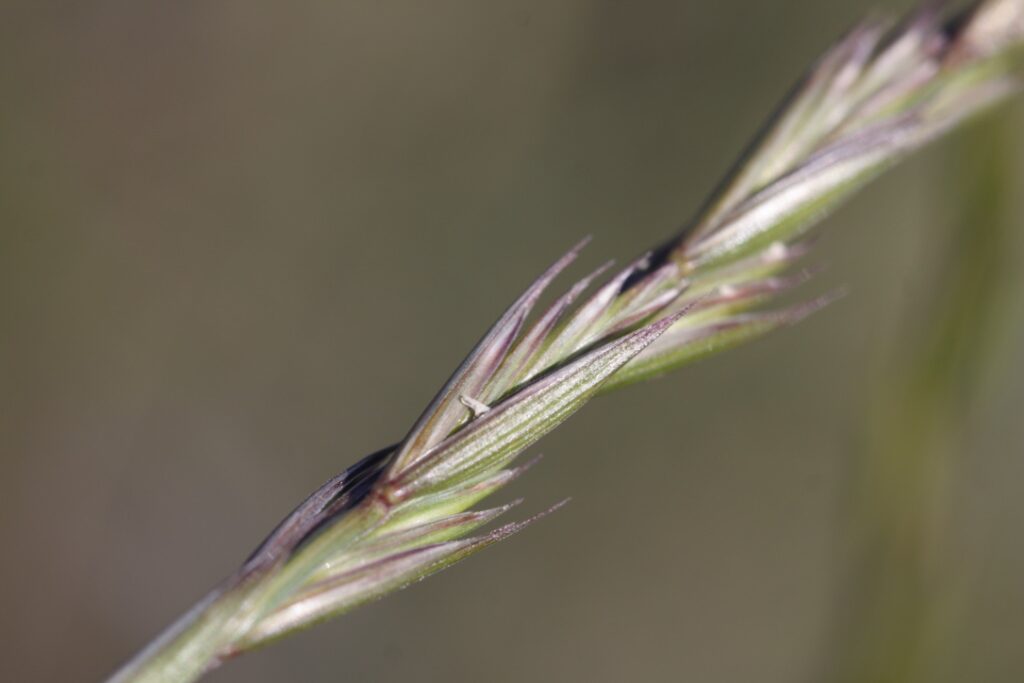
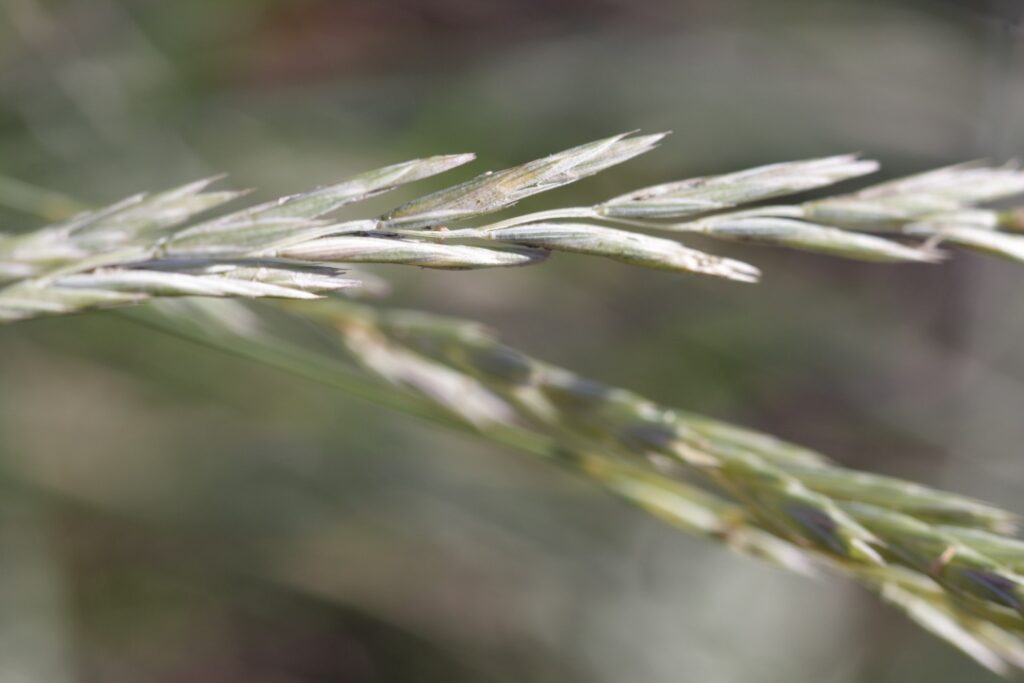
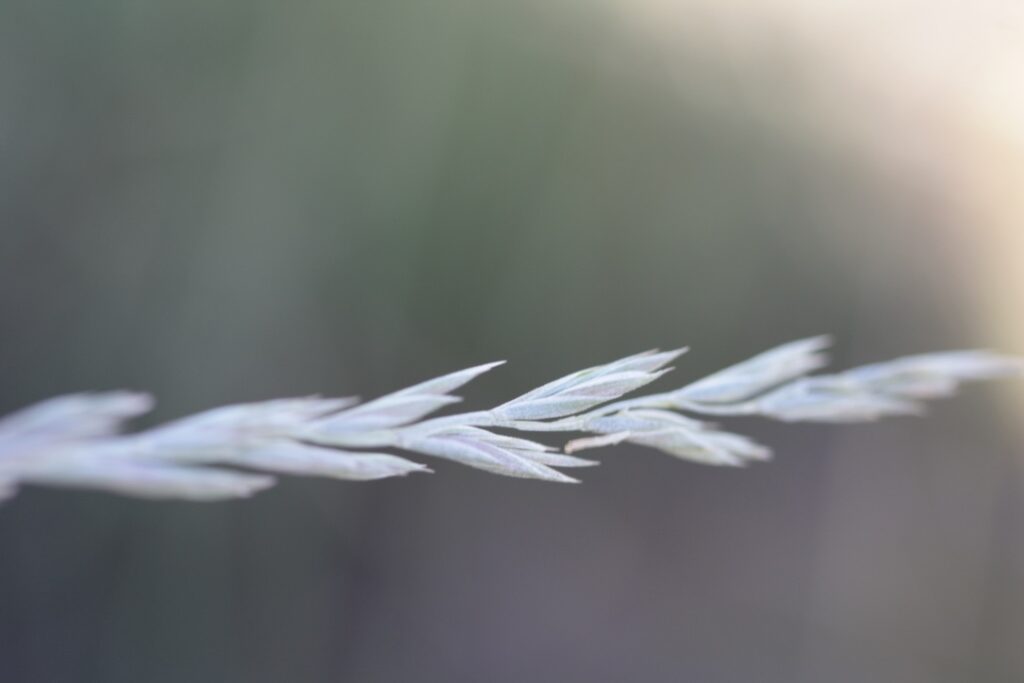
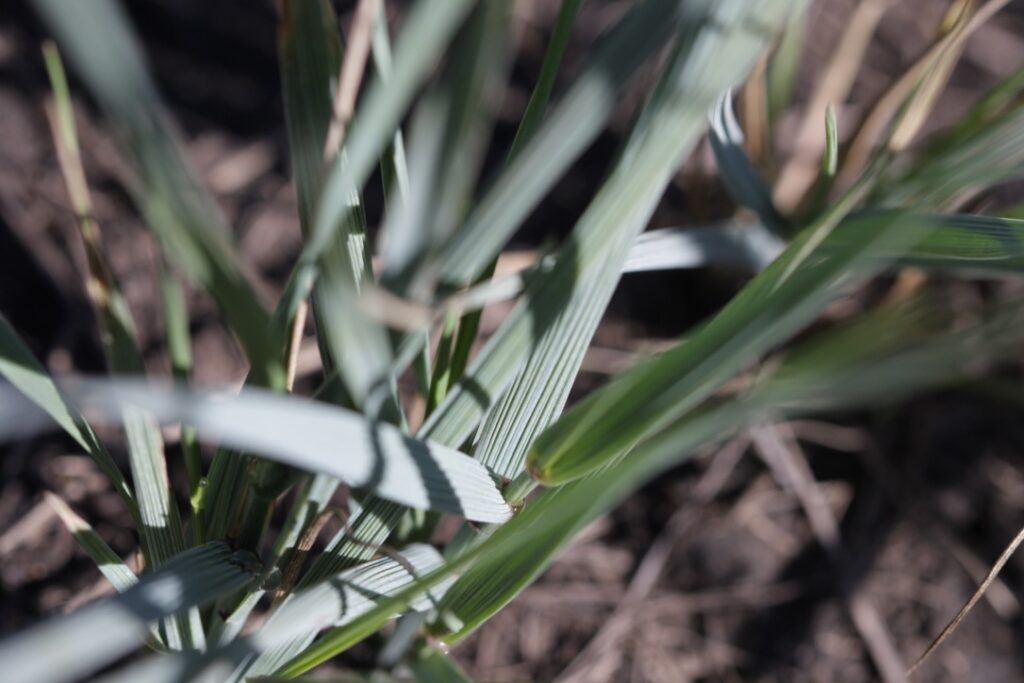
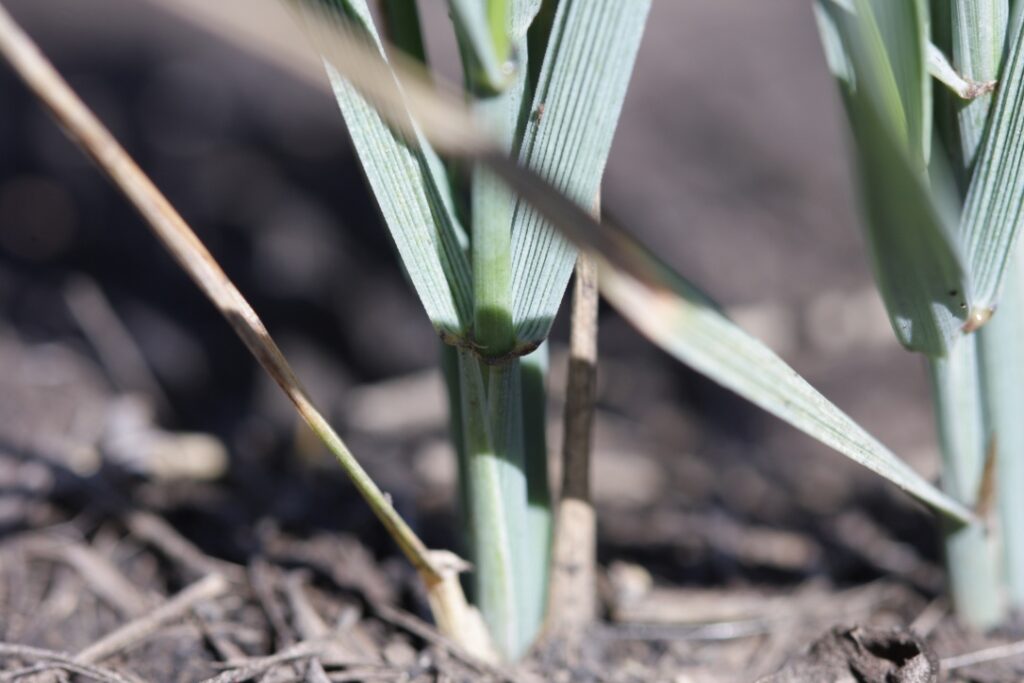
Leaves & Collars
Origin & Status
- Native or non-native to Western Canada? Native.
- If non-native, where is it considered a native species? N/A
- Is this plant generally considered a nuisance weed or not? No.
- Common or rare? Common.
Dichotomy-like Description
Growth Habit
- Erect, prostrate, creeping, or climbing? Erect.
- What is its life cycle? Perennial.
Overall Height
- Up to 60 cm (24 inches) tall.
Stem Characteristics
- Bunched or creeping-rooted? Creeping.
- Pithy or hollow? Hollow.
- Square, round, or triangular? Round.
Rooting Type
- Rhizomes present? Yes.
- If rhizomes present, are they short or long? Long; extensive.
- Shallow or deep-rooted? Deep-rooted, but mostly shallow roots due to rhizomatous growth.
Leaf & Collar Characteristics
Leaf width:
- Wide or narrow? Wide.
- Rolled, flattened, indented? Flat to inrolled
- Lax or stiff? Stiff
- What width? To 6 mm
Leaf tip:
- Boat-shaped or sharply pointed? Sharply pointed.
Other leaf characteristics:
- Hairy or glabrous? Roughened (rarely hairy) above, smooth below.
- Margins smooth or roughened? Roughened.
- Any particular colouration to note? Glaucous, bluish to purplish-green.
- Rolled or folded at emergence? Rolled.
Sheath shape/structure? Round, split.
- What type of venation? Conspicuous.
- What colour characteristics? Brownish or purplish at base; margins pale.
- With hairs or hairless? Hairless.
Ligule present? Yes.
- If yes, what is its shape & structure? Membranous, truncate, lacerate or hair-fringed.
- If yes, how long is it? Up to 0.5 mm long.
Collar shape/structure? Continuous, medium-broad,
- What structure[s] describes its size? Not well-defined, sometimes oblique.
- What colouration? Light green.
- Hairs or hairless? Hairless.
Auricles present? Yes.
- If yes, are they distinct or rudimentary? Distinct.
- If distinct, are there clasping claws or similar? Clasping claws.
- If rudimentary, are there clasping claws or rounded extensions? N/A
- If yes, are claws equal or not? Mostly equal.
- If yes, what is their size? 0.2 to 1 mm
Other characteristics to note? Leaves grow 45 degrees from the stem.
Inflorescence Type
Raceme, panicle, or spike? Spike
- Length of inflorescence? 5 to 17 cm
If spike:
- Number of spikelets or flowers per node or joint: 6 to 10 flowered.
- Imbricate (overlapping, layered or shingled) or not? Yes; fairly closely imbricate, sometimes 2 per node.
- Long or short rachilla? Short: 0.8 to 2 mm long, 0.5 to 0.9 mm wide at the top (spikelet axis)
- Attached edgewise, flatwise, or otherwise to the stem (esp. for those in Tribe Triticeae)? Attached flatwise.
Inflorescence Colour
Is there any notable colouration to note on the inflorescence, spikelets and/or florets? Glaucous, same colour as leaves below.
Spikelet & Floret Sizes
- Length of spikelets: 12 to 26 (30) mm
- Length of glumes: 5 to 15 mm; lower ones 0.15 to 0.8 mm wide at 3/4 length.
- Length of lemmas/paleas: 6 to 14 mm
- Length of florets: not noted
- Length of awns (if present): 0.5 to 5 mm
Inflorescence Composition
How many florets are there per spikelet, including sterile? 2 to 12 florets
- Glumes unequal or equal? Unequal: broadest at base, lower glumes usually exceeded by upper glumes.
- Glumes shorter, equal to, or longer than either lemmas, palea, or florets? Often as long as lowest lemma.
- Lance-shaped, awl-shaped, egg-shaped, or other notable shape? Not noted.
- Pointed, awned, or dull? Awned, mostly; may appear rudimentary.
- Straight or twisted awn? Straight awn.
- Where is the awn attached from? Top (apex) of glume.
Hairs on any parts of the flower? Hairless
- If so, which structures? N/A
Seeds
- What is the size? N/A
- What is the shape? N/A
- Hairless or has hairs? N/A
- Are there any other features to note? N/A
Where to Find This Species
What ecoregions and habitats does this plant most commonly occur in? P. smithii is best known for its abundance in the Prairie Ecoregion, or common to the dry and moist mixed-grass prairies. Populations also can be found in drier areas (hillsides, badlands, sunny exposed sites) of the Aspen Parkland and Foothills ecoregions.
What plant community is this plant found in, or occupies as the dominant species? It is considered a climax species along with Blue Grama (Bouteloua gracilis), June Grass (Koelaria macrantha), and Needle & Thread Grass (Hesperostipa comata).
Which states/provinces can this species be found in? Alberta, British Columbia, Manitoba, Ontario, Saskatchewan, Quebec; Alaska, Arkansas, Arizona, California, Colorado, Georgia, Kansas, Kentucky, Indiana, Idaho, Iowa, Illinois, Maryland, Montana, Minnesota, Missouri, Oregon, New York, Nevada, New Hampshire, New Mexico, North Dakota, Nebraska, Ohio, Oklahoma, South Dakota, Texas, Tennessee, Utah, Washington, Wisconsin, Wyoming.
When to Find Blooms/Inflorescences
What time of year is this plant most likely to bloom? What seasons to expect, and what months of the year? Ths species also typically blooms from May to June, occasionally into early July, depending on seasonal weather conditions.
Is this Species Safe or Hazardous to Animals?
Is this species known for posing a hazard for humans and animals, particularly with awns? No, it is a forage species that is generally considered safe for animals to consume.
Synonyms & Other Names
Other scientific names this plant is or has historically been known by:
- Agropyron elmeri Scribner
- Agropyron smithii Rydberg
- Agropyron smithii Rydberg var. smithii
- Agropyron smithii var. molle (Scribner & Smith) Jones
- Agropyron smithii var. palmeri (Scribner & J.G. Smtih) A. Heller
- Agropyron spicatum var. molle Scribner & J.G. Smith
- Elymus smithii (Rydberg) Gould
- Elytrigia smithii (Rydberg) Nevski
- Pascopyrum smithii (Rydberg) Á. Löve nom. inval.
- Zeia smithii (Rydberg) Lunell
Other common names this plant has been known by (English only):
- Bluestem Wheatgrass
- Blue-joint Wheatgrass
- Western Couch Grass
- Red-Joint Wheatgrass.
The former two names were due to the species’ distinct colour, and the latter because of the reddish colouration of the nodes. However, these names should not be confused with Little Bluestem (Schizachyrium scoparium) or Big Bluestem (Andropogon gerardi).
What Other Species Can this be Confused With?
What other species may you confuse this with?
- Thickspike (Northern) Wheatgrass (Elymus lanceolatus ssp. lanceolatus)
- Intermediate Wheatgrass (Thinopyrum intermedium)
- Slender Wheatgrass (Elymus trachycaulus ssp. trachycaulus)
What are any details to help distinguish this species from others? The distinguishing characteristics of P. smithii are the bluish-green tinge of the leaves, the stiff, erect nature of the leaves at a 45-degree angle from the culm, and its shorter stature compared to these other species.
Interesting Notes
Is there any value of this plant for grazing herbivores, both domesticated and wild? The forage value of P. smithii is fair to good for all classes of livestock and fair to pronghorn, deer, and other wildlife. Crude protein content averages 18% in the spring and decreases significantly to 3 to 4% by mid to late fall when plants have reached full maturity. However, the digestible carbohydrates have increased by 40 to 50% during this period, proving their ability to cure well on the stem and make for good fall and winter forage. It is valued as good native hay and can also be utilized as a stockpiled grazing resource for livestock (and historically bison, similar to Festuca hallii) during winter.
This species is regarded as a “decreaser” in arid regions due to its sensitivity to lack of moisture. However, in areas that receive better moisture, it is considered an “increaser” because it can withstand more grazing pressure and maintain a healthy population stand where it can be competitive with other grass species for space, nutrients, and moisture. In some areas it will become part of a climax plant community.
What pollinators love to visit, if applicable? N/A
Is it commonly used for reclamation purposes? P. smithii is a popular native species used in land reclamation projects because of its rhizomatous nature and its tolerance to alkaline or saline areas. It will readily move into disturbed areas and work its way along trails. There is no shortage of seed available on the commercial market for such projects. Unfortunately, its seeds have poor germination, so the best-recommended way to propagate P. smithii is by daughter tillers from rhizomes.
Any stories about name origins or name meanings to share? No.
P. smithii is considered opportunistic in its growth habits: it starts regrowth early in the spring, shortly after the frost has left the ground, and, after setting seed, it goes dormant during the hot summer months. It will grow again in the fall if there is adequate soil moisture. This species grows from seed as well as from daughter tillers that have been established from the parent plants. Plants also produce relatively short rhizomes.
Links for More Information
- iNaturalist – https://www.inaturalist.org/taxa/156649-Pascopyrum-smithii
- Texas A&M Lady Bird Johnson – https://www.wildflower.org/plants/result.php?id_plant=pasm
- Alberta Biology Monitoring Institute – https://abmi.ca/species/pascopyrum-smithii
- Montana Field Guide – https://fieldguide.mt.gov/speciesDetail.aspx?elcode=PMPOA7M010
- USDA Plants Profile (or similar) – https://plants.sc.egov.usda.gov/DocumentLibrary/factsheet/pdf/fs_pasm.pdf and http://fs.usda.gov/database/feis/plants/graminoid/passmi/all.html
- E-flora BC – https://linnet.geog.ubc.ca/Atlas/Atlas.aspx?sciname=Pascopyrum+smithii